Don't marry someone with whom you could not share this website.
Approach with Caution...

A few misfires from the history of philosophy.

.jpg/:/cr=t:6.03%25,l:0%25,w:93.97%25,h:93.97%25/rs=w:370,cg:true,m)

Tyrants or Armed Prophets & Wisdom ≠ Moderation
Fr. Frederick Copelston, S.J. (1907-1994):
“[P]political thought at the close of the Middle Ages still moved, to a great extent, within the general framework of mediaeval political theory. In the political philosophy of Marsilius of Padua we can certainly discern a strong tendency to the exaltation of the self-sufficiency of the State and to the subordination of Church to State; but the general outlook of Marsilius, as of kindred thinkers, lay under the influence of the common mediaeval dislike of absolutism…
“In England we witness the rise of the Tudor absolutism, which began with the reign of King Henry VII (1485-1509), who was able to establish centralized monarchic power at the close of the Wars of the Roses…In France the Hundred Years War constituted a set-back to the growth of national unity and the consolidation of the central power; but when in 1439 the Estates agreed to direct taxation by the sovereign for the purpose of supporting a permanent army, the foundation of monarchic absolutism was laid. When France emerged from the Hundred Years War in 1453, the way was open for the establishment of the absolute monarchy which lasted until the time of the Revolution. Both in England, where absolutism was comparatively short-lived, and in France, where it enjoyed a long life, the rising class of merchants favoured the centralization of power at the expense of the feudal nobility. The rise of absolutism meant the decay of the feudal society. It meant also the inauguration of a period of transition between mediaeval and ‘modern’ conceptions of the State and of sovereignty…
“This does not mean, of course, that the political theories of the Renaissance period were all theories of monarchic despotism. Catholics and Protestants were at one in regarding the exercise of sovereign power as divinely limited. For example, the famous Anglican writer, Richard Hooker, was strongly influenced by the mediaeval idea of law as divided into eternal, natural and positive law, while a Catholic theorist like Suarez insisted strongly on the unchangeable character of natural law and the indefeasibility of natural rights. The theory of the divine right of kings, as put forward by William Barclay in his De regno et regali potestate (1600), by James I in his Trew Law of Free Monarchies and by Sir Robert Filmer in his Patriarcha (1680), was not so much a theoretical reflection of practical absolutism as an attempt to support a challenged and passing absolutism. This is especially true of Filmer’s work, which was largely directed against both Catholic and Protestant opponents of royal absolutism. The theory of the divine right of kings was not really a philosophical theory at all. Philosophers like the Calvinist Althusius and the Catholic Suarez did not regard monarchy as the sole legitimate form of government. Indeed, the theory of the divine right of kings was a passing phenomenon, and it was eminently exposed to the type of ridicule with which John Locke treated it...
“But though the consolidation of centralized power and the growth of royal absolutism did not necessarily involve the acceptance of absolutism on the plane of political theory, they were themselves the expression of the felt need for unity in the changing economic and historical circumstances; and this need for unity was indeed reflected in political theory. It was reflected notably in the political and social philosophy of Machiavelli who, living in the divided and disunited Italy of the Renaissance, was peculiarly sensible to the need for unity...
“Niccolo Machiavelli (1469-1527) is celebrated for his attitude of indifference towards the morality or immorality of the means employed by the ruler in the pursuit of his political purpose, which is the preservation and increase of power. In The Prince (1513) which he addressed to Lorenzo, Duke of Urbino, he mentions such good qualities as keeping faith and showing integrity and then observes that ‘it is not necessary for a prince to have all the good qualities I have enumerated, but it is very necessary that he should appear to have them’…
“It has been said that in The Prince Machiavelli was concerned simply to give the mechanics of government, that he prescinded from moral questions and wished simply to state the means by which political power may be established and maintained. No doubt this is true; but the fact remains that he obviously considered the ruler entitled to use immoral means in the consolidation and preservation of power. In the Discourses he makes it quite clear that in his opinion it is legitimate in the sphere of politics to use an immoral means in order to attain a good end. It is true that the end which Machiavelli has in mind is the security and welfare of the State; but, quite apart from the immoral character of the implied principle that the end justifies the means, the obvious difficulty arises that conceptions of what is a good end may differ. If morality is to be subordinated to political considerations, there is nothing but the actual possession of power to prevent political anarchy.
“This does not mean that Machiavelli had any intention of counselling widespread immorality. He was perfectly well aware that a morally degraded and decadent nation is doomed to destruction; he lamented the moral condition of Italy as he saw it and he had a sincere admiration for the civic virtues of the ancient world. Nor do I think that one is entitled to state without any qualification that he explicitly rejected the Christian conception of virtue for a pagan conception...When, in The Prince, Machiavelli remarks that many men have thought that the world's affairs are irresistibly governed by fortune and God, and when he goes on to say that, although he is sometimes inclined to that opinion, he considers that fortune can be resisted, implying that virtue consists in resisting the power which governs the world, it is difficult to avoid the impression that 'virtue' meant for him something different from what it means for the Christian…
“But, though Machiavelli regarded the absolute monarch or legislator as necessary for the foundation or reformation of the State, absolute monarchy was not his ideal of government. In the Discourses he roundly asserts that, in respect of prudence and constancy, the people have the advantage and are ‘more prudent, more steady and of better judgment than princes'. The free republic, which was conceived by Machiavelli on the model of the Roman Republic, is superior to the absolute monarchy. If constitutional law is maintained and the people have some share in the government, the State is more stable than if it is ruled by hereditary and absolute princes…
“On the other hand, one must remember that Machiavelli was concerned with actual political life as he saw it and with what is actually done rather than with what ought to be done from the moral point of view. He expressly disclaims any intention of depicting ideal States and he remarks that if a man lives up consistently to the highest moral principles in political life, he is likely to come to ruin and, if he is a ruler, to fail to preserve the security and welfare of the State. In the preface to the first book of the Discourses, he speaks of his new ‘way', which, he claims, has been hitherto left untrodden. His method was one of historical induction.”

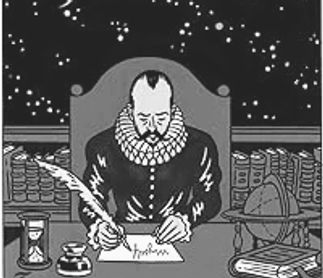
Niccolo Machiavelli
Positivism & Co.
Max Horkheimer (1895-1973):
“It is often said that all the problems that philosophy has tried to solve are either meaningless or can be solved by modern experimental methods. In fact, one of the dominant trends in modern philosophy is to hand over to science the work left undone by traditional speculation. Such a trend toward the hypostatization of science characterizes all the schools that are today called positivist…
“According to the positivists, what we need is abundant confidence in science. Of course they are not blind to the destructive uses to which science is put; but they claim that such uses of science are perverted. Is this really so? The objective progress of science and its application, technology, do not justify the current idea that science is destructive only when perverted and necessarily constructive when adequately understood…
“Anxiety lest scientific authority be undermined has seized scholars at the very time when science has become generally accepted and even tends to be repressive. The positivists would discriminate against any kind of thought that does not conform perfectly to the postulate of organized science. They transfer the principle of the closed shop to the world of ideas. The general monopolistic trend goes so far as to engulf the theoretical concept of truth. This trend and the concept of a ‘free market in the world of ideas’ advocated by Hook are not as antagonistic as he thinks. Both reflect a businesslike attitude toward matters of the spirit, a preoccupation with success…
“If science is to be the authority that stands firm against obscurantism— and in demanding this the positivists continue the great tradition of humanism and the Enlightenment— philosophers must set up a criterion for the true nature of science. Philosophy must formulate the concept of science in a way that expresses human resistance to the threatening relapse into mythology and madness, rather than further such a relapse by formalizing science and conforming it to the requirements of the existing practice. To be the absolute authority, science must be justified as an intellectual principle, not merely deduced from empirical procedures and then made absolute as truth on the basis of dogmatic criteria of scientific success."
On Pragmatism
“If it were not for the founder of the school, Charles S. Peirce [1839-1914], who has told us that he ‘learned philosophy out of Kant,’ one might be tempted to deny any philosophical pedigree to a doctrine that holds not that our expectations are fulfilled and our actions successful because our ideas are true, but rather that our ideas are true because our expectations are fulfilled and our actions successful. Indeed, it would be doing Kant an injustice to make him responsible for this development. He made scientific insight dependent upon transcendental, not upon empirical functions. He did not liquidate truth by identifying it with the practical actions of verification, nor by teaching that meaning and effect are identical. He tried ultimately to establish the absolute validity of certain ideas per se, for their own sake. The pragmatistic narrowing of the field of vision reduces the meaning of any idea to that of a plan or draft."
On Empiricism
“Empiricism abolishes the principles by which science and empiricism itself could possibly be justified. Observation in itself is not a principle, but a pattern of behavior, a modus procedendi, which at any time may lead to its own abolition. If at any time science should change its methods, and if observation, as it is practiced today, were no longer observable, it would be necessary to modify the ‘philosophical’ principle of observation and revise philosophy accordingly, or to uphold this principle as an irrational dogma. This weakness of positivism is covered by the positivists’ implicit assumption that the general empirical procedure used by science correspond naturally to reason and truth. This optimistic belief is perfectly legitimate for any scientist engaged in actual, non-philosophical research, but for a philosopher it seems the self-delusion of a naive absolutism."
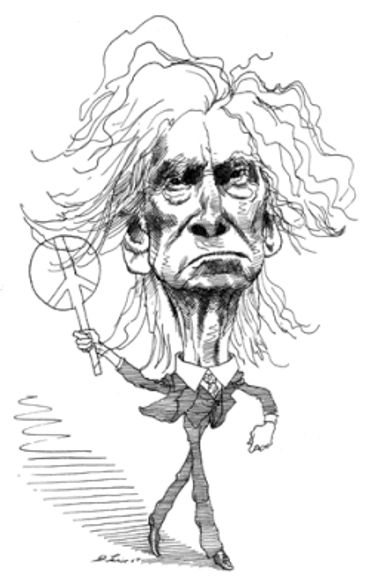
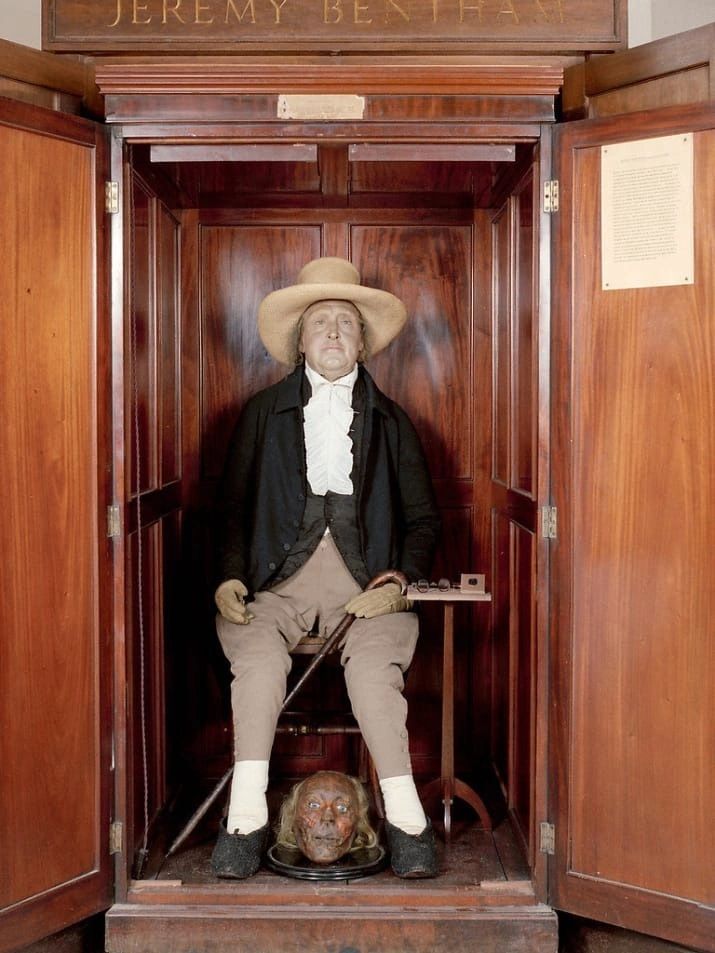
Jeremy Bentham (1747-1832)
Way past his freshness date, in every sense of the phrase.
"I cannot help persuading myself, that the disputes between contending parties—between the defenders of a law and the opposers of it, would stand a much better chance of being adjusted than at present, were they but explicitly and constantly referred at once to the principle of UTILITY. The footing on which this principle rests every dispute, is that of matter of fact; that is, future fact--the probability of certain future contingencies…
"All else is but womanish scolding and childish altercation, which is sure to irritate, and which never can persuade.--‘I say, the legislature cannot do this--I say, that it can. I say, that to do this, exceeds the bounds of its authority--I say, it does not?’...
"On the other hand, had the debate been originally and avowedly instituted on the footing of utility, the parties might at length have come to an agreement; or at least to a visible and explicit issue—‘I say, that the mischiefs of the measure in question are to such an amount.—I say, not so, but to a less.—I say, the benefits of it are only to such an amount.—I say, not so, but to a greater.'—This, we see, is a ground of controversy very different from the former. The question is now manifestly a question of conjecture concerning so many future contingent matters of fact: to solve it, both parties then are naturally directed to support their respective persuasions by the only evidence the nature of the case admits of;— the evidence of such past matters of fact as appear to be analogous to those contingent future ones.”
Double Truth, False Humanism, Platonists & Averroists
Will Durant (1885-1981):
“Two elements of life entered to revive philosophy [in the 15th century]: the conflict between Platonists and Aristotelians, and the division of Aristotelians into orthodox and Averroists. At Bologna and Padua these conflicts became veritable duels, literally matters of life and death. The humanists were mostly Platonists; under the influence of Gemistus Pletho, Bessarion, Theodorus Gaza, and other Greeks, they drank deeply of the wine of the Dialogues, and could hardly understand how anyone could bear the arid logic, impotent Organon and leaden golden mean of the cautious Aristotle…[Fr. Marsilio Ficino, 1433-1499,] studied widely, going so far afield as to Zoroaster and Confucius. When he reached Plotinus, and himself translated the Enneads, he felt that he had found in mystic Neoplatonism the silken cord that would bind Plato to Christ. He tried to formulate this synthesis in his Theologia platonica, a confused medley of orthodoxy, occultism, and Hellenism, and arrived hesitantly at a pantheistic conclusion: God is the soul of the world…
“But there was something to be said for Aristotle, especially if he could be misinterpreted. Was Aquinas right in understanding him to teach personal immortality, or was Averroes right in reading De anima as affirming the deathlessness of only the collective soul of mankind?…Nicoletto Vernias [1420-1499], as professor of philosophy at Padua (1471-99), appears to have taught there the doctrine that only the world-soul, not the individual soul, is immortal; and his pupil Agostino Nifo [1473-1538] propounded the same notion in a treatise De intellectu et daemonibus (1492). Usually the skeptics sought to soothe the Inquisition by distinguishing (as Averroes had done) between two kinds of truth—religious and philosophical: a proposition, they urged, might be rejected in philosophy from the standpoint of reason, while still accepted on faith in the word of Scripture or the Church. Nifo professed the principle with reckless simplification; Loquendum est ut plures, sentiendum ut pauci— ‘We must speak as the many do, we must think as the few.’ Nifo changed his mind or his speech as his hair changed, and reconciled himself to orthodoxy…
“Pietro Pomponazzi [1462-1525], the microscopic bombshell of Renaissance philosophy, was so diminutive that his familiars called him Peretto— ‘little Peter.’…All the skeptical tradition of Padua descended to him and culminated in him; as his admirer Vanini was to put it, ‘Pythagoras would have judged that the soul of Averroes had transmigrated into the body of Pomponazzi.’…
“Pomponazzi continued to teach at Padua from 1495 to 1509; then the winds of war swept through the city, and closed its historic University halls. In 1512 we find him established at the University of Bologna. There he remained to the end of his days, marrying thrice, always lecturing on Aristotle, and modestly likening his relation to his master to that of an insect exploring an elephant." He thought it safer to offer his ideas not as his own but as implied or explicit in Aristotle interpreted by Alexander of Aphrodisias…The Fifth Council of the Lateran, under the presidency of Leo X (1513), condemned all who should assert that the soul is one and indivisible in all men, and that the individual soul is mortal. Three years later Pomponazzi published his major work, De immortalitate animae in which he sought to show that the condemned view was precisely that of Aristotle. Mind, said Pietro’s Aristotle, is at every step dependent upon matter; the most abstract knowledge is ultimately derived from sensation; only through the body can mind act upon the world; consequently a disembodied soul, surviving the mortal frame, would be a functionless and helpless wraith. As Christians and faithful sons of the Church, Pomponazzi concluded, we are warranted in believing in the immortality of the individual soul; as philosophers we are not…
“The book ran into a storm. The Fransciscan friars persuaded the doge of Venice to order all procurable copies to be publicly burned, which was done. Protests were made to the papal court, but [the humanists] Bembo and Bibbiena were then high in Leo’s councils, and advised him that the conclusions of the book were perfectly orthodox; the conclusions were. Leo was not fooled; he knew quite well this little trick of the two truths; but he contented himself with ordering Pomponazzi to write a decent word of submission. Pietro complied in Apologiae libri tres (1518), reasserting that as a Christian he accepted all the teaching of the Church. About the same time Leo commissioned Agostino Nifo to compose an answer to Pomponazzi’s book; as Agostino loved controversy, he executed this assignment with pleasure and skill. It is remarkable, and perhaps illustrates a continuing antipathy between the universities and the clergy, that while Pomponazzi’s head hung, so to speak, in this Inquisitorial balance, three universities competed for his services…
“In two minor books, which he did not publish in his lifetime, Pomponazzi continued his skeptical campaign. In De incantatione he reduced to natural causes many supposedly supernatural phenomena. A physician had written to him about cures allegedly due to incantations or charms; Pietro bade him doubt. “It would be ridiculous and absurd,” he wrote, “to despise what is visible and natural in order to have recourse to an invisible cause the reality of which is not guaranteed to us by any solid probability.” As a Christian he accepts angels and spirits; as a philosopher he rejects them; all causes under God are natural. Reflecting his medical training, he laughs at the widespread belief in occult sources of cure: if spirits could cure the ills of the flesh they would have to be material, or use material means, to affect a material body; and he ironically pictures the healing spirits as rushing about with their paraphernalia of plasters, ointments, and pills. However he admits certain curative powers in some plants and stones. He will accept the miracles of the Bible, but suspects that they were natural operations. The universe is governed by uniform and invariable laws. Miracles are unusual manifestations of natural forces whose powers and methods are only partly known to us; and what the people cannot understand they ascribe to spirits or to God. Without contradicting this view of natural causation, Pomponazzi accepts much of astrology. Not only are the lives of men subject to the action of the heavenly bodies, but all human institutions, he thinks, even including religions, rise and flourish and decay according to celestial influences. This is true also of Christianity; at the present moment, says Pomponazzi, there are signs that Christianity is dying. He adds that as a Christian he rejects all this as nonsense…
“He pictured himself in his later years as worn and haggard with thought about it and about, and likened the philosopher to Prometheus, who, because he wished to steal fire from heaven— i.e., snatch at divine knowledge— was condemned to be bound to a rock and to have his heart gnawed at by a vulture endlessly. ‘The thinker who inquires into the divine mysteries is like Proteus…The Inquisition persecutes him as a heretic, the multitude mocks him as a fool.’…
“Pomponazzi had put into philosophic form a skepticism that had for two centuries been attacking the foundations of Christian belief. The failure of the Crusades; the influx of Moslem ideas through Crusades, trade, and Arab philosophy; the removal of the papacy to Avignon and its ridiculous division in the Schism; the revelation of a pagan Greco-Roman world full of wise men and great art and yet without the Bible or the Church; the spread of education, and its increasing escape from ecclesiastical control; the immorality and worldliness of the clergy, even of popes, suggesting their private disbelief in the publicly professed creed; their use of the idea of purgatory to raise funds for their purposes; the reaction of the rising mercantile and moneyed classes against ecclesiastical domination; the transformation of the Church from a religious organization into a secular political power: all these factors, and many more, combined to make the Italian middle and upper classes, in the late fifteenth and early sixteenth century, ‘the most skeptical of European peoples.’
“It is clear from the poetry of Politian and Pulci, and the philosophy of Ficino, that the circle of Lorenzo had no actual belief in another life; and the sentiment of Ferrara appears in the fun that Ariosto makes of the inferno that to Dante had seemed so frightfully real. Almost half the literature of the Renaissance is anticlerical. Many of the condottieri were open atheists; the cortigiani or courtiers were far less religious than the cortigiane or courtesans; and a polite skepticism was the mark and requisite of a gentleman. Petrarch lamented the fact that in the minds of many scholars it was a sign of ignorance to prefer the Christian religion to pagan philosophy…”
The Cult of Nature

Paul Johnson (1928-2023):
Jean-Jacques Rousseau, 1712-1778, “was the first of the modern intellectuals, their archetype and in many ways the most influential of them all. Older men like Voltaire had started the work of demolishing the altars and enthroning reason. But Rousseau was the first to combine all the salient characteristics of the modern Promethean: the assertion of his right to reject the existing order in its entirety; confidence in his capacity to refashion it from the bottom in accordance with principles of his own devising; belief that this could be achieved by the political process; and, not least, recognition of the huge part instinct, intuition and impulse play in human conduct. He believed he had a unique love for humanity and had been endowed with unprecedented gifts and insights to increase its felicity. An astonishing number of people, in his own day and since, have taken him at his own valuation. In both the long and the short term his influence was enormous. In the generation after his death, it attained the status of a myth. He died a decade before the French Revolution of 1789 but many contemporaries held him responsible for it, and so for the demolition of the ancien régime in Europe...During the Revolution the National Convention voted to have his ashes transferred to the Panthéon. At the ceremony its president declared: ‘It is to Rousseau that is due the health-giving improvement that has transformed our morals, customs, laws, feelings and habits.’ At a much deeper level, however, and over a far longer span of time, Rousseau altered some of the basic assumptions of civilized man and shifted around the furniture of the human mind. The span of his influence is dramatically wide but it can be grouped under five main headings.
“First, all our modern ideas of education are affected to some degree by Rousseau's doctrine, especially by his treatise Emile (1762). He popularized and to some extent invented the cult of nature, the taste for the open air, the quest for freshness, spontaneity, the invigorating and the natural. He introduced the critique of urban sophistication. He identified and branded the artificialities of civilization. He is the father of the cold bath, systematic exercise, sport as character-forming, the weekend cottage.
“Second, and linked to his revaluation of nature, Rousseau taught distrust of the progressive, gradual improvements brought about by the slow march of materialist culture; in this sense he rejected the Enlightenment, of which he was part, and looked for a far more radical solution. He insisted that reason itself had severe limitations as the means to cure society.
"That did not mean, however, that the human mind was inadequate to bring about the necessary changes, because it has hidden, untapped resources of poetic insight and intuition which must be used to overrule the sterilizing dictates of reason. In pursuit of this line of thought, Rousseau wrote his Confessions, finished in 1770, though not published until after his death. This third process was the beginning both of the Romantic movement and of modern introspective literature, for in it he took the discovery of the individual, the prime achievement of the Renaissance, a giant stage further, delving into the inner self and producing it for public inspection. For the first time readers were shown the inside of a heart, though--and this too was to be a characteristic of modern literature--the vision was deceptive, the heart thus exhibited misleading, outwardly frank, inwardly full of guile.
“The fourth concept Rousseau popularized was in some ways the most pervasive of all. When society evolves from its primitive state of nature to urban sophistication, he argued, man is corrupted: his natural selfishness, which he calls amour de soi, is transformed into a far more pernicious instinct, amour-propre, which combines vanity and self-esteem, each man rating himself by what others think of him and thus seeking to impress them by his money, strength, brains and moral superiority. His natural selfishness becomes competitive and acquisitive, and so he becomes alienated not only from other men, whom he sees as competitors and not brothers, but from himself. Alienation induces a psychological sickness in man, characterized by a tragic divergence between appearance and reality. The evil of competition, as he saw it, which destroys man's inborn communal sense and encourages all his most evil traits, including his desire to exploit others, led Rousseau to distrust private property, as the source of social crime.
“His fifth innovation, then, on the very eve of the Industrial Revolution, was to develop the elements of a critique of capitalism, both in the preface to his play ‘Narcisse’ and in his Discours sur l'inégalité, by identifying property and the competition to acquire it as the primary cause of alienation. This was a thought-deposit Marx and others were to mine ruthlessly, together with Rousseau's related idea of cultural evolution. To him, ‘natural’ meant ‘original’ or pre-cultural. All culture brings problems since it is man's association with others which brings out his evil propensities: as he puts it in Emile, ‘Man's breath is fatal to his fellow men.’ Thus the culture in which man lived, itself an evolving, artificial construct, dictated man's behaviour, and you could improve, indeed totally transform, his behaviour by changing the culture and the competitive forces which produced it--that is, by social engineering…"
Discourse on the Arts and Sciences:
“The power of the French intellectuals was just beginning and was to increase steadily in the second half of the century. But in the 1740s and 1750s their position as critics of society was still precarious… In July 1749 Diderot was arrested and put in solitary confinement in the Vincennes fortress for publishing a book defending atheism. He was there three months. Rousseau visited him there, and while walking on the road to Vincennes he saw in the paper a notice from the Dijon Academy of Letters inviting entries for an essay competition on the theme ‘Whether the rebirth of the sciences and the arts has contributed to the improvement of morals’. This episode, which occurred in 1750, was the turning point in Rousseau's life. He saw in a flash of inspiration what he must do. Other entrants would naturally plead the cause of the arts and sciences. He would argue the superiority of nature. Suddenly, as he says in his Confessions, he conceived an overwhelming enthusiasm for ‘truth, liberty and virtue’. He says he declared to himself: 'Virtue, truth! I will cry increasingly, truth, virtue!' He added that his waistcoat was ‘soaked with tears I had shed without noticing it’. The soaking tears may well be true: tears came easily to him. What is certain is that Rousseau decided there and then to write the essay on lines which became the essence of his creed, won the prize by this paradoxical approach, and became famous almost overnight. Here was a case of a man of thirty-nine, hitherto unsuccessful and embittered, longing for notice and fame, at last hitting the right note. The essay is feeble and today almost unreadable. As always, when one looks back on such a literary event, it seems inexplicable that so paltry a work could have produced such an explosion of celebrity; indeed the famous critic Jules Lemaître called this instant apotheosis of Rousseau ‘one of the strongest proofs ever provided of human stupidity’.
"Publication of the Discours on the arts and sciences did not make Rousseau rich, for though it circulated widely, and evoked nearly three hundred printed replies, the number of copies actually sold was small and it was the booksellers who made money from such works. On the other hand it gave him the run of many aristocratic houses and estates, which were open to fashionable intellectuals.”
Two Variations on the "Via Moderna"
Br. Benignus of Jesus, F.S.C.:
“To accept as the immediate and sole content of perception discrete, particular, sensuous impressions - sensations or bare sense qualities - is to rule out of the primary cognitive act any understanding of the extramental reason or ground of these sensa and to enclose oneself in an unbreakable circle of pure phenomena with no knowable substance or cause as their ground. This is the road taken by Hume and all sensists, and the road which Kant tried to escape, but unsuccessfully. To affirm that direct experience gives only particulars, with nothing at all of the universal, is to cut oneself off from all hope of justifying any inferential knowledge, whether inductive or deductive, since both depend upon the universal. This is the error of nominalism and it is, of course, closely allied to the sensist error…
“In [the] teaching of Aristotle and St. Thomas it is clearly stated that in the perceptive judgment the first principles of demonstration are implicitly present, as are universal concepts in general, or the terms by which demonstration is carried out. The principles and universals are attained through induction, which is made possible by the co-operation of external sense, internal sense, especially cogitative and memory, and intellect…
“The extramental object of the direct perceptive judgment contains explicitly a concrete existing singular having a determinate nature. The act whereby this object with its three aspects (the singular, its existence, its nature) is grasped, is sensio-intellectual. Man is neither brute nor angel. His mind grasps what is presented through the senses to the understanding as something existing. St. Thomas writes that sense apprehends the nature or implicit universal; but he does not mean sense in isolation from intellect. In the perceptive judgment there are not a sensitive act and an intellectual act; there is a sensio-intellectual act. Because this one act is sensitive it grasps the material particular; because it is intellective it grasps the being and nature of this particular. The nature is grasped as a potential, fundamental, or implicit universal and is grasped in the individual--Callias as this man...The operation of abstraction follows the grasp of the singular; after grasping
Callias as this man and Socrates as this man, the intellect frees the nature 'man' from the individual conditions in which it is originally presented, and makes it an explicit or real universal…
“Demonstrative syllogistic reasoning moves from premises which are certain to a conclusion which is necessarily implied by these premises. Thus, the two premises, All men are mortal and
Socrates is a man, necessarily imply the conclusion Socrates is mortal. The major premise itself, however, must have been attained by the mind as a certain truth before the syllogism is formulated. There is no use saying that we got it from a previous syllogism, for that way of thinking can lead only to an infinite regress of syllogisms. What is needed, if any syllogism is to be demonstrative, is some truths which are not themselves syllogistically demonstrated but which are yet certain and which can stand as starting points for syllogistic demonstration…
“Aristotle and St. Thomas are telling us how we form our universal ideas and judgments and how we arrive at knowledge of first principles. We may call the process abstraction or, as Aristotle does, induction. Or we may distinguish two parts in it, and call the former abstraction and the latter induction. Then we have an answer to the problem which perplexes so many of our contemporary philosophers and scientists; namely, What is the basic justification for inductive judgments?…In the perceptive act they admit the grasp only of particulars; but a true and certain induction requires a universal; since, therefore, they cannot see how the mind can justify its passage from the particular to the universal, they cannot see how induction is really warranted. Yet, of course, they must go on making and using inductive generalizations if they wish to pursue philosophy or science. Many have chosen to consider every inductive conclusion as incomplete and provisional in theory, though usable as a true universal in practice…
“When we perceive something, we perceive it as an individual ‘existing under a common nature,’ that is, we know Callias ‘not only inasmuch as he is Callias, but also inasmuch as he is this man, and, in like manner, Socrates inasmuch as he is this man.’ Because man is given as well as Callias and Socrates, the mind apprehends a determinate nature or character as well as a particular thing. It can consider this nature separately, and that is what we mean by abstraction. From the complex object, this man or Callias, the mind abstracts or considers apart one aspect only, namely man. ‘And thence it is, that from such an antecedent grasp by sense, the intellective soul
can consider “man” in both of them.’ Clearly, we could not abstract man from the data of perception if man were not in those data. St. Thomas was fully aware of the difficulty that nominalists must find in respect to induction: 'But if, on the contrary, the case were that sense apprehended only that which belongs to particularity, and in no manner apprehended the universal in the particular, it would not be possible that knowledge of the universal could be caused in us from the apprehension of sense.' Abstraction is possible only because the universal is given fundamentally in perception; and induction is possible only because abstraction is possible.”
Fr. William of Ockham, O.F.M.
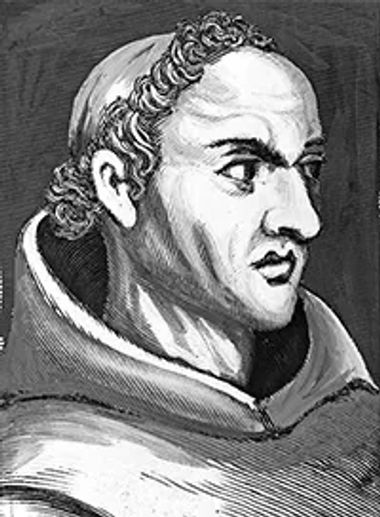
Friar William (1287-1347) is mostly remembered for his doctrine, known as "Occam's Razor", that “nothing ought to be posited without a reason given, unless it is self-evident or known by experience or proved by the authority of Sacred Scripture.” This has variously been boiled down to “Don’t multiply entities beyond necessity,” or "The simplest explanation is probably the true one."
Fr. Henri Renard, S.J.:
Fr. Henri Renard, S.J.:
“[William of] Occam was led to a denial of everything that is not the individual. For him there is, therefore, no such problem as individuation; there are no principles of being. Substance is either identified with accidents, or it is a mere idea. But prime matter is an existing being, and hence the individual will be a composite not of many principles but of many beings. Finally (and in this Occam seems more logical than Scotus), since we have no other intuition except that of the singular, and this is had by a concept, no other knowledge is required, and, consequently, no other is had. Abstraction is a word; the universal a mere name. With the destruction of the universal as the source of certain scientific knowledge, Occam destroys all metaphysical certitude of principles and of natures, and prepares the way for the empiricism and skepticism of Hume…
“It is extremely important at this juncture to understand that substance is not a substratum, into which, so to speak, the accidents are stuck. Indeed, many of the difficulties brought against substance by the modern philosophers (Bergson, for example) have their origin in the misconception of substance as a dead, inert, unchangeable substratum into which the various accidents are pasted like paint on the wall. This these philosophers believe to be the scholastic view of substance, and they naturally reject it. Now nothing could be farther from the dynamism of the act and potency theory of the Angelic Doctor. It is true such a doctrine was proposed by some of the later scholastics, and enjoyed a certain degree of popularity. To this sad fact must be attributed, at least in part, the collapse of scholasticism in the eighteenth and nineteenth centuries. For with the progress of experimental science, since these smaller entities which those philosophers called accidents, and the larger ones which they called the substances, could in no way be isolated in the laboratory, the entire doctrine of accidents as distinct from substance fell in disrepute, and the theories of Descartes, modified and made to fit the modern physical terminology, became the vogue.
“The philosophers simply forgot the true object of philosophy. They transferred matter and form, substance and accidents, which are in the order of the principles of being, into the realm of physics or order of phenomena; and thought they could demonstrate the existence of these philosophophysical monstrosities by chattering about them. The physical properties of bodies pertain to the order of experience, and a certain knowledge of them is the result of laborious experimentation in the laboratory. On the other hand some scientists did not show themselves much wiser. They imagined that science was philosophy, and, consequently, whatever they came in contact with in their laboratory work was declared to be an ultimate philosophic reality in the order of being…
“Substance, therefore, is by no means a dead, inert substratum. It is the principle of being, and, as nature, the principle of action. Although not essentially changed by these new determinations called accidents, it is nevertheless modified in a very real manner by them, so that while remaining the same substance it is made more or less perfect by the constant, successive, one might almost say, by the continuous becoming that is taking place. Hence, our definition of substance is not, as certain recent writers have asserted, that which remains unchanged while accidents come and go, but it is, we repeat, that whose quiddity is to be not in another.
“Our concept of substance, therefore, is the solution of our search for the absolute as a basis for the relative...”